SASSY'S REVIEW
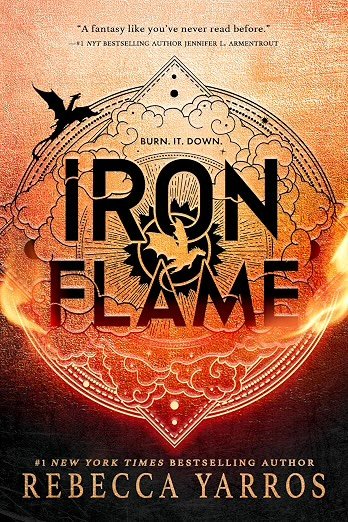
❖I went into Iron Flame with about fifty questions left over from Fourth Wing, along with more than a few theories about Lilith, Violet’s father, Navarre’s conveniently edited version of history, Xaden’s secrets, and exactly how much the dragons knew that the humans didn’t. I actually got answers to quite a few of those questions. Some confirmed that my suspicious little brain hadn’t been completely barking up the wrong tree, while others made me look at certain characters and their choices very differently than I had before. There are also things I questioned in Fourth Wing, especially when it comes to Violet’s father and what he may have known, that Iron Flame only made me more curious about.
And the dragons? Yeah. I was right about them not telling the humans everything. Those dragons have quite a few secrets of their own. 😂
So I definitely know more than I did when I finished Fourth Wing, but somehow knowing more only made everything more complicated. By the end of Iron Flame, I wasn’t questioning whether Violet had been lied to anymore. I wanted to know exactly who knew what, how long they had known it, what else was still being hidden, and whether some of the people I had already made up my mind about deserved another look. I basically started this book looking for answers and finished it with some answers, several revised theories, and another fifty freakin’ questions.
One of the things I liked most about Iron Flame was watching the world get bigger. Fourth Wing started cracking open everything Violet believed about Navarre, but this book takes those doubts much further. Violet can no longer blindly trust the history she was taught, the people who taught it to her, or even some of the people she loves. She has to start looking at the information in front of her and deciding for herself what she actually believes.
I have to give myself a little credit here because one of my biggest suspicions after Fourth Wing was that something was seriously wrong with the official history. I questioned who controlled those records, what might have been deliberately left out, and whether the version everyone had been taught was really the whole truth. Iron Flame gave me plenty of reasons to keep right on questioning it. I’m deliberately not saying exactly what Violet finds because discovering those inconsistencies is part of the story, but different accounts don’t always agree, little details matter, and sometimes the problem comes down to how something written generations ago has been understood.
I really enjoyed that part of the story because it brought Violet’s years of training to become a scribe right back into play. Becoming a powerful rider hasn’t replaced the intelligent woman we met in Fourth Wing. She researches, compares information, questions what she has been taught, notices when things don’t add up, and keeps digging for answers. Her mind is still every bit as important to her survival as her signet or her dragons, and I love that the series hasn’t forgotten that.
Her physical limitations haven’t magically disappeared either. Violet is stronger, more experienced, and more capable now, but the story still acknowledges what her body can and cannot do. She continues to adapt instead of suddenly becoming physically indestructible simply because she survived first year. I appreciated that in Fourth Wing, and I was glad to see it continue here.
Of course, surviving first year doesn’t mean Basgiath suddenly becomes a pleasant place to be, and Vice Commandant Varrish quickly became one of my biggest problems with second year. There’s a difference between believing Basgiath’s brutal methods are necessary and actually seeming to enjoy having the power to hurt and control people, and Varrish crossed that line for me pretty quickly. His interest in Violet creates some of the more uncomfortable parts of the story, but it also shows just how important the relationships Violet built during Fourth Wing have become.
Rhiannon, Ridoc, Sawyer, and the others aren’t simply people Violet trains beside anymore. They have become her people, and that found-family side of this series continues to be one of my favorite parts. What I especially liked was that those friendships weren’t treated as something Violet could simply put on hold while she dealt with everything else happening around her. Keeping secrets from the people she loves has consequences, even when she genuinely believes she is protecting them.
That also forces Violet to confront something I thought she needed to learn, especially considering how angry she is with Xaden. There is a difference between protecting someone and deciding for them what they should be allowed to know. Violet has very good reasons for keeping certain things from her friends, but eventually she has to recognize that good intentions don’t automatically make that choice fair. Considering how much she hates having other people make those decisions for her, I thought it was important that the story made her look at the fact that she was beginning to do some of the same thing herself.
That brings me to Violet and Xaden, because these two definitely tested my patience in this book. I completely understood Violet’s anger after Fourth Wing. She hadn’t discovered that Xaden kept one little secret from her. She had just learned that much of what she believed about her world wasn’t true, only to discover that the man she trusted had also been keeping some pretty enormous things from her.
At the same time, I understood Xaden’s side of it too. Not every secret he carries belongs only to him, and other people’s lives depend on his ability to keep some of them. I don’t think it would have been reasonable for Violet to expect him to start handing over information that could put other people in danger simply because they were in a relationship. The actual conflict between them made sense to me; what frustrated me was how long they kept circling around the same argument.
Violet wants Xaden to volunteer information because she sees that as part of rebuilding trust, while Xaden insists that she ask him what she wants to know. The obvious problem is that Violet can’t ask about something she doesn’t know exists. I could understand what both of them were trying to say, but there were times when I wanted them to sit down and actually define what honesty meant to each of them instead of having another variation of the same fight.
They’re also both a little hypocritical about the whole thing. Violet hates having someone else decide what information she can handle while occasionally doing her own version of that to her friends. Xaden wants her to ask questions while knowing perfectly well there are things she doesn’t know enough to ask about. Neither one of them is completely wrong, but neither one is completely right either, which is why I wouldn’t call this manufactured relationship drama. They have a legitimate trust problem to work through. I just didn’t need to watch them work through the same part of it quite so many times.
Thankfully, their relationship still worked for me underneath that frustration. Xaden continues to respect Violet’s abilities and helps her become stronger rather than trying to make her dependent on him. Violet challenges him instead of simply accepting whatever he tells her, and neither of them suddenly becomes a different person just because they’re in love. Their chemistry is also very much alive, but just like in Fourth Wing, the sexual side of their relationship never takes over the actual story.
Then Cat comes into the picture, and I’ll admit she got on my nerves at first. I have very little patience for women being turned into rivals simply because they have history with the same man, and Cat certainly knows how to push Violet’s buttons where Xaden is concerned. I always wonder why two women have to let a man come between them in the first place. Just once, I’d love for them to look at each other, realize they actually like each other, become best friends, and leave the man standing there wondering whether allowing this friendship to continue is eventually going to ruin his life. 😂
So naturally, I wasn’t exactly excited when it looked like Violet and Cat might be heading straight into that familiar female-rival/mean-girl territory. Thankfully, Cat eventually becomes more complicated than simply being another woman who wants Xaden. There are other things driving her behavior, and once I understood more about her and what was happening between the two women, some of Violet’s reactions made a lot more sense too.
I liked their dynamic much better once they were put into situations where their personal problems had to take a back seat to bigger things. They don’t suddenly become best friends, which unfortunately ruins my plan of having the two of them join forces just to make Xaden nervous, but they do begin seeing each other as more than competition over a man. They can dislike each other, recognize each other’s strengths, and still work together when something more important is at stake. I’ll take that over dragging a jealousy fight through the rest of the series any day.
Dain surprised me too, especially after everything I had to say about him in my Fourth Wing review, and very little of that was flattering. Iron Flame gives him an opportunity to become more complicated than the childhood friend who thinks he knows what is best for Violet. I don’t want to explain exactly what happens because I think readers should get there themselves, but when Dain is forced to question some of the things he believed, I paid much more attention to what he chose to do afterward.
That doesn’t erase his behavior in Fourth Wing, and I wouldn’t want the story to pretend that it does. I can, however, appreciate a character who screws up, has to face what his choices caused, and is given room to grow from it. I’ll even admit there were moments when I liked Dain again, although I would appreciate everyone not making me say that too loudly after everything I said about that man in the first review.
Lilith was another character I watched very closely because my opinion of her had already started changing toward the end of Fourth Wing. I originally wondered what kind of mother would send Violet into the Riders Quadrant with only six months to prepare, but by the end of that book I was questioning whether I had misunderstood her reasons entirely. I even wondered whether putting Violet with the riders might have been Lilith’s strange way of protecting her from something she knew Violet could eventually uncover if she followed her original path and became a scribe.
Iron Flame doesn’t completely prove that theory, so I’m not taking a victory lap over that one yet, but I’m definitely not throwing it away either. What this book does make clear is that Lilith is much more complicated than the cold, uncaring mother I thought I understood when I first met her. I still don’t agree with all of her choices, and that woman desperately needed to learn how to communicate with her children, but some of what I learned in this book made me look back at her earlier decisions very differently.
That brings me right back to Violet’s father because Iron Flame did absolutely nothing to make me stop questioning him either. I wondered after Fourth Wing whether he had discovered something he wasn’t supposed to know and whether there might have been more to his death than Violet believed. This book does not prove that he was murdered, and I don’t want to present my theory as though it does, but his research comes back into the story in a way that gave me even more reasons to wonder what Papa Sorrengail knew before he died.
Considering everything Violet is discovering about dragons, hidden information, and how unreliable the history she was taught can be, I have an even harder time believing her father’s research is being mentioned for no reason. I still want to know exactly what he discovered, who knew about his work, and whether any of it connects to what happened to him. My imaginary conspiracy board definitely still has his name sitting somewhere near the middle with quite a bit of red string attached to it.
Andarna is tangled up in some of those questions too. She continues to be one of my favorite parts of the series, and watching her change and develop more of her own personality was a lot of fun. There are some pretty important discoveries involving her in Iron Flame that I’m deliberately leaving out because I think readers deserve to experience them without me ruining them.
What I can say is that what we learn about Andarna made me even more curious about Violet’s father and his research, what the dragons know, and whether there are connections between some of these things that Violet still hasn’t figured out. I already suspected the humans didn’t know nearly as much about dragonkind as they thought they did, and I finished Iron Flame even more convinced that the dragons have their own history and their own reasons for deciding what they share with humans.
Tairn remains one of my favorites as well. I still love his relationship with Violet because he recognizes her limitations without ever treating her like she is helpless, and his personality continues to make their conversations some of my favorite moments. We also get more glimpses into the dragons themselves and their relationships with one another, which only made me want to know more about what is happening on their side of this story.
And remember when I said I didn’t think Jack Barlowe was quite as simple as he appeared? I told you so, and I’m just going to leave that right there. Anything else I say about Jack starts wandering straight into spoiler territory, but I knew there was something about that man that didn’t add up.
The larger world was another part of Iron Flame I really enjoyed. We finally get outside the little bubble Violet knew in Fourth Wing and begin meeting people and seeing places she previously understood almost entirely through Navarre’s version of events. Once people who have spent years being taught to see each other as enemies actually have to interact, the story becomes much less black-and-white.
I especially liked that years of distrust don’t magically disappear simply because there is a larger threat. These people have different experiences, abilities, loyalties, and versions of history, and they have legitimate reasons to be suspicious of one another. Watching them slowly learn when they can work together felt much more believable to me than everyone suddenly deciding they were friends because the plot needed them to be.
The more Violet sees for herself, the harder it becomes for her to divide the world neatly into good people and bad people, and I think that is one of the biggest ways the story grows in Iron Flame. She isn’t just learning that Navarre lied anymore. She is beginning to understand how those lies shaped the way she saw people she had never even met.
Where Iron Flame struggled a little for me was the pacing. There is a lot happening in this book between Basgiath, the rebellion, Violet and Xaden’s relationship, new characters, old secrets, politics, dragons, research, hidden history, training, and the larger war. At times the book moves incredibly fast, while other parts slow down enough that I noticed the length much more than I ever did with Fourth Wing.
I didn’t think the story needed less plot because most of those pieces genuinely interested me. I think it needed a slightly better balance. Spending a little less time circling the same Violet and Xaden trust argument would have given some of the larger developments more room to breathe without actually removing anything important from the story.
That was probably the biggest difference between my experience reading the two books. Fourth Wing pulled me through almost effortlessly, while Iron Flame had a few stretches where I could feel the pacing and repetition. Even then, I was never bored enough to stop caring because I still wanted answers. I wanted to know what Violet would discover, what everyone was hiding, what was happening with the dragons, and which pieces of the history we had been given could actually be trusted.
Once those different pieces started coming together toward the end, putting the book down was pretty much out of the question. I’m going to be extremely careful about those final chapters because there are several discoveries that readers deserve to experience for themselves, but Rebecca Yarros managed to answer some very big questions while simultaneously giving me an entirely new collection of things to obsess over.
I finished Iron Flame still wondering what Violet doesn’t know about her father, exactly how much Lilith knew and when she knew it, what else the dragons are keeping to themselves, and whether there is an even bigger connection between Violet and Andarna than we currently understand. There is also a rather large question about Violet herself that I suspect is going to matter going forward, but even explaining why I’m asking it would give away more than I want to reveal here.
The ending added an entirely different set of questions about power, control, choice, and whether crossing a particular line automatically determines what someone becomes afterward. Considering how many supposedly unquestionable truths have already fallen apart in these first two books, I’m not quite ready to accept that the rules surrounding that are as simple as everyone believes either.
Looking back at all those theories I carried over from Fourth Wing was actually one of the more fun parts of reading this book. I was right to distrust Navarre’s version of history, right that the dragons knew more than they were telling the humans, right that Lilith had more going on than Violet understood, and definitely right that there was more happening with Jack Barlowe than his obsession with killing Violet suggested.
A couple of my bigger theories are still sitting firmly in the “I have absolutely no proof, but I’m not letting them go” category. I still wonder whether Lilith sent Violet to the Riders Quadrant partly to protect her from whatever she might have uncovered as a scribe, and I’m still suspicious about Violet’s father discovering something dangerous before he died. Iron Flame didn’t prove either one, but it certainly didn’t convince me to cross them off my list.
Instead, I finished this book adding even more questions about Andarna, Papa Sorrengail’s research, what the dragons still aren’t saying, what Violet herself may not know yet, and how much of the enemy everyone truly understands. Apparently my imaginary conspiracy board is going to need to be a little bigger before I start the next book.
For me, Iron Flame lands at ⭐⭐⭐⭐ 4/5 stars. There is easily a five-star story here, and I loved where the larger plot went, but the uneven pacing and the amount of time Violet and Xaden spent circling the same trust conflict kept the actual reading experience from quite reaching Fourth Wing for me. None of those issues ever made me want to stop reading, though. I was still invested in these characters, still trying to figure everything out alongside Violet, and still completely invested in whatever those secretive dragons are up to.
For spice, I’m giving Iron Flame 🌶️🌶️🌶️ 3/5 Peppers. There are explicit on-page scenes and plenty of chemistry between Violet and Xaden, but the sexual content never overtakes the story. There is far too much happening with the characters, dragons, politics, secrets, history, and larger conflict for their relationship to become the only focus.
Review By: SASSY
Owner • Creator • Queen of the Chaos
SassyReviews.com
Read, Reviewed, & BookDragon Approved… or Not.
"You cannot make an informed choice without being given the truth."