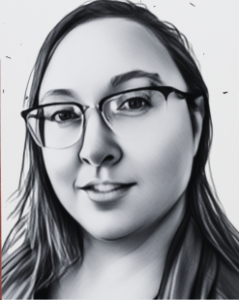
Rory McCauley-Hayman
Author of Twisted Design Series
Who is Rory when she isn’t creating fictional people, building entire universes, and emotionally damaging perfectly innocent readers? In this Spotlight, we’re getting to know the woman behind the stories and taking a look at the creative chaos that goes into bringing them to life, from the fictional men occupying an obscene amount of space in her head to the real-life experiences that have found their way into her books. We’ll also venture into the Twisted world for some behind-the-scenes details about The Rogue Queen and The Vampire’s Servant, before finding out what she has planned for us next.
STRAIGHT FROM THE SOURCE
❖Readers can find an official author bio, but give us the version they can’t Google. Who is Rory when she isn’t creating fictional people and ruining perfectly good readers emotionally?
I’m also something of a caretaker. I love helping people and being a source of support when I can. That has gotten me into trouble before, but apparently I haven’t learned my lesson, because I keep doing it.
Outside of books and writing, what are you genuinely passionate about?
English. Okay, hear me out, I am soooo terrible at other languages. I’ve had classes in Spanish, French, and Japanese and can only barely understand the basics if I strain. My reading comprehension is better, but only if the Japanese is using romaji, because if the kanji comes out, I am totally lost.
But I had linguistics classes for my Strategic Communications degree and one of them was the history of the English language. I didn’t do well, but I loved it. And now people buy me linguistics books and books about the history of punctuation.
What’s something about you that longtime readers would probably be genuinely surprised—or delighted—to learn?
Dilly, however, has more of my personality traits than his. When I wrote Dilly, my husband was a Cisco Certified Network Administrator and was in charge of our network and network security, so Dilly’s technical knowledge and abilities were heavily influenced by him.
What is something your family or closest friends would immediately describe as “such a Rory thing”?
Do you have a hobby, collection, obsession, tradition, or completely random interest your readers probably know nothing about?
Give us one completely useless Rory fact whose only purpose is making readers stop and say, Wait… what?
I have never seen what my characters look like, but if I see a picture of them, I can definitely tell if it is them or not.
When life becomes entirely too “people-y” and you need to disappear for a while, what does your perfect escape look like?
Writing. I used to go lay down in my room and stare at the wall or ceiling as words appeared in my head, and then I would mold them into my personal stories and headcanons. But when I lost the ability to do that, I found that writing gave me that ability back. I go into my office, play my music, and stare at a screen until words start to form in my head. Then I just go with it.
Someone magically clears your entire schedule for 24 hours. No deadlines, emails, responsibilities, chores, or humans requiring your attention. What are you doing?
What is your most irrational pet peeve?
What harmless opinion will you defend as though your entire reputation depends on it?
What did your life look like before becoming an author? Was writing always something you imagined yourself doing, or did that dream sneak up on you later?
I was a stay-at-home mom for most of my young adult life. My family had some significant care needs, and there was a lot of work to be done at home, so I couldn’t realistically do that while working outside the home.
For most of my twenties, I wrote poetry and exactly two short stories, but I couldn’t write anything longer. I’d lose interest, or I’d outline the entire story so thoroughly that I knew exactly how it would flow and how it would end. Once I knew the ending, I didn’t want to write the rest of it. Apparently, I needed to discover that being a writer and being someone who likes knowing how things end are not always compatible.
The funny thing is that I never actually wanted to be a writer. I was good at research papers and essays, so I eventually got my English degree, but my goal was to become a librarian, specifically a research librarian. I was working toward qualifying for a Master’s program at an ALA-accredited school.
And then 2019 happened, and my plans changed.
Writing wasn’t something I’d dreamed about my entire life. It was something I eventually stumbled into after my life took a direction I hadn’t expected. I’m not sure I would’ve believed you if you’d told me I’d become an author.
Do you remember the moment you first thought, I could actually write a book? What finally convinced you to stop thinking about it and start writing?
This was actually very bad for me. I used my stories to relieve stress and get to sleep. They were my soothing thing, the thing that helped calm my mind. I’d never had anything like that happen before, so I decided I would try to save the last story that was still in my head. It was a “The Flash” fan fiction with my daydream original character, who I had honed over three decades of daydreams. She is perfection. So I started writing.
For the first time in days, the story started flowing in my head. It was working. I could daydream, but only when I was on my computer, so I basically stopped sleeping while I wrote the story.
Three days later, I realized I needed some story in front of where I had started. Then I thought, wouldn’t this be kind of cool if I shifted the characters around? Suddenly, it wasn’t a DCAU fan fiction starring the most kickass heroine of my life. It was “Noncorporeal”, which is what I named it later.
Noelle is the closest I will probably ever get to writing my daydream persona. A few weeks later, I realized, This could be a book. Or even a series. I was still only writing for me at that point. Then somehow it turned into all of this. I’m kind of addicted to writing, and all of you are my enablers.
What publishing path have you taken, and what made it the right choice for you?
Serialized publishing let me put my work in front of readers while I was still writing it, and their response gave me the encouragement to keep going.
If you could sit down with the Rory who was preparing to release her first book, what would you tell her now?
Readers see the finished book, but they rarely see everything that happens behind it. What is something about writing, editing, publishing, marketing, and getting a book into readers’ hands that you wish more readers understood?
Keeping things straight is hard to do even if you are organized. Some of my favorite authors have messed up details about characters from several books back, and as a reader, I didn’t understand how they could have gotten something so basic wrong. Once I became a writer and started writing characters who popped in from other books, magic systems that were very detailed, and world histories that I had to make mesh with the real world, I realized what a pain it can be.
There are a lot more moving pieces behind a book than readers ever see, and sometimes something is going to slip through.
Looking at everything you’ve created since then, what are you most proud of?
I am just proud that I have done this and that I’ve found friends who also like the worlds I write. That part means a lot to me. I started out writing stories that existed entirely in my own head, so having other people enjoy those worlds with me is something I never expected.
Is there something you’ve accomplished that you don’t think you have ever really stopped and given yourself enough credit for?
Where do your characters normally come from? Do you deliberately build them piece by piece, or do fictional strangers essentially move into your brain, refuse to pay rent, and start making demands?
I do not control them and we fight a lot
Which character arrived practically fully formed, and which one fought you every damn step of the way?
Felix from the Twisted Design series fought hard when I wanted to write a story about him. He is a very private person and didn’t want me telling people about him. He was barely okay with the small appearances he had in the main series. The short story was a pain.
Have you ever written a character who was supposed to have a tiny role only to watch them look at your carefully constructed plans and essentially say, That’s adorable. This is my story now?
Instead, I have a man who was literally described as looking like a mafia goon from old cartoons. And don’t you even start to think it was only Noelle’s fault. Cal had no shame about his interest in Noelle. He thought it was funny!
Has a character ever completely changed the direction of a story you thought you were writing?
Which character became FAR more popular with readers than you anticipated? Were you completely unsurprised, or did you have a HIM?! THAT’S WHO WE’RE ALL OBSESSED WITH?! moment?
Rhett the warlock was another surprise. Because my characters dictate which story I will write, my original publishing order had The Feral Heart coming out before The Healing Souls. Originally, Rhett had a much smaller part when I played through The Healing Souls, but then I had to expand it because his bit part in The Feral Heart had people asking about the mysterious, flirty warlock.
That was on me, no surprise there. I actually used a video game character I had a minor crush on when I was younger as his base. Who doesn’t love a chaotic-good pirate who loves to flirt but doesn’t do relationships? One of my changes was to make Rhett more chaotic-neutral.
Which of your characters do you think readers misunderstand the most?
I would classify her as a service top, which is why she lets Josh work through his dominant urges with her and why she will submit to Stanton when they are in public. But when Stanton needs her to possess him, she works to make sure she does it in a way that will support him most.
Which character has the most Rory hidden inside them?
Are pieces of your personality, experiences, relationships, conversations, or real life secretly tucked into any of your stories?
Is there an Easter egg, recurring joke, personal reference, name, location, or seemingly insignificant detail in one of your books that means considerably more to you than readers probably realize?
Squirrels are assholes. Something the readers did pick up on. I was mugged by two squirrels one day, and this is my revenge.
Green is my husband’s favorite color, so I add it into the lists of favorite colors for my male leads who remind me most of him. Dilly’s eyes are green because, aside from his personality, he is most like my husband in his interests and intensity.
Without spoilers, is there a particular scene or reveal you could barely wait for readers to reach?
What is one of the most emotionally difficult scenes or character arcs you’ve ever written? Without spoiling it, why did that particular one affect you?
Have you ever made yourself cry while writing and then had the audacity to leave the scene exactly that devastating for the rest of us?
Have you ever written something so dark, emotional, spicy, twisted, or completely unhinged that even you stopped and thought, Rory… what the hell?
Which book was the most fun to write, and which one came closest to causing your computer to become airborne?
I never really had one that made me want to throw my computer, though The Healing Souls came close. I was trying to bring in a couple of the short stories and put them into a larger story together with the aftermath of The Vampire’s Servant and the beginning of The Witch’s Temptation. It was also a good place to show more of the world beyond shapeshifters, witches, and vampires.
What does your writing space actually look like during a deadline: cozy author sanctuary or literary crime scene?
What is your most ridiculous procrastination technique?
If someone had never read one of your books and you could put only ONE book or series into their hands, which would you choose, and why?
Is there one particular book, series, couple, or fictional world that holds an especially personal place in your heart?
Actually, The Demon Queen’s Desire exists because I wanted Noelle and Cal’s first meeting to go a different way. I started writing it because of that, and then it grew on its own and became a supernatural story with a similar base but very different characters.
Is there a book from your backlist that you wish more readers would discover? This is your opportunity to tell us why we’ve apparently been sleeping on it.
Noelle is a hero and a villain, and I adore her. Cal is very different from most of my male leads, and I really enjoyed watching the alien lore evolve as the books progressed and the characters grew. That combination made this one of my favorite series to reread.
Is there a character, couple, or world readers refuse to let you leave behind? Is there hope for them, or should everyone begin the grieving process?
Rhett the warlock. He was meant to come in just so I could write him, because he was in my head and wanted attention. And the readers wanted to give it to him. He lost a lot in his life, but he gains a lot as the series goes on from his first appearance.
Rock and Carmen. We met them in the short “Love Is Blind,” and I got SOOO many people asking for more that I had to make them a whole book, The Healing Souls. People also wanted more of Dennis and Billie from the short “The Vampire’s Second Chance,” so they ended up in The Healing Souls as well.
Which character would you trust with your life?
Which character would you absolutely NOT trust with your drink?
Lock any three of your characters in a room for 24 hours purely for your own amusement. Who are you choosing?
If your characters could anonymously review you as their author, what would your average rating be—and what would the one-star reviews complain about?
The one-star reviews would likely be from people who didn’t get what they wanted. Wendy from The Feral Heart would definitely say, “I would have given her zero stars, but I had to give at least one to leave this review.”
When you get to turn your author brain off and simply read, what genres and tropes do you naturally gravitate toward?
Outside of fiction, I enjoy some biographies, linguistics, and history. I also read a lot of manga, especially shōjo, isekai, slice of life, and romance.
As for tropes, I honestly don’t pay much attention to them. I could probably name one or two if someone challenged me, but I don’t choose books based on tropes. I usually just find a story that sounds interesting and go from there.
What trope will you probably never get tired of?
Is there a popular trope that simply does not work for you?
Was there a particular book or author who significantly influenced you as a writer?
Which fictional character written by another author owns an unreasonable amount of real estate in your head?
I wasn’t particularly fond of Blair and Leander, but being able to see both relationships from each twin’s perspective was fun. Still, I only read it for more Kane.
Which author would reduce you from professional writer to completely incoherent fangirl if you unexpectedly met them?
Jude Deveraux. This one is kind of obvious at this point.
Charlaine Harris. I’m a fan of several of her series, although I wasn’t particularly fond of the television shows based on them.
Patricia Briggs. She lives less than a one-day drive from me, but I restrain myself.
Steal one character from another author and drop them into your universe. Who are you kidnapping, and what havoc are they causing?
Someone gives you $500, but you are legally prohibited from spending a single dollar responsibly. What are you buying?
Or the whole light-novel series of The Apothecary Diaries and all the foods I love from my favorite restaurants.
Do you remember the first time it really hit you that complete strangers were reading—and becoming emotionally invested in—people and worlds that had previously existed only inside your imagination?
But when comments started coming in that showed people were really enjoying the stories and getting attached to the characters, I was shaking from the overwhelming emotion of having created something that others loved. I write for myself, and my little stories have always been for me. I didn’t realize that other people could really love them as much as I did.
What is the funniest, sweetest, strangest, or most memorable message, review, gift, or comment you have received from a reader?
But the one comment that has always stuck in my head was from a reader who wrote to me and said she wanted to crack open my head so she could live inside my mind. I took a screenshot of it because it was probably the strangest comment I’ve ever received, but it was also incredibly relatable.
What does it mean to you when someone tells you one of your books gave them an escape, made them laugh when they needed it, helped them through something difficult, or simply made their life a little better for a few hours?
Additionally, the stories in my head would keep me sane when everything was removed from my space, including books. Those stories were everything to me. When someone tells me that my books helped them in the ways my mental stories helped me, it honestly makes me teary. This is what they were meant for, and knowing they helped someone else really makes my heart feel full.
What do you wish readers understood about the actual human being behind a book when they are reading, rating, reviewing, or discussing someone’s work?
When you first imagined the world that eventually became The Rogue Queen and The Vampire’s Servant, what came first: the world, the romance, a particular character, or one completely unhinged scene that demanded an entire story be built around it?
The Rogue Queen is one of those titles that immediately promises a woman who probably isn’t going to sit quietly while somebody else makes decisions for her. How early in the writing process did you know exactly who your queen was going to be?
Was there anything about your Rogue Queen that changed dramatically between the character you originally imagined and the woman readers ultimately met?
When creating a powerful heroine, how do you balance letting her be genuinely formidable without removing the vulnerability, mistakes, fears, or emotional messiness that make readers care about her?
They are people first, and being powerful is only one part of who they are.
Did you know from the beginning how large and interconnected this world was going to become, or did the characters gradually hijack what you thought was a much simpler plan?
If the characters from The Rogue Queen could read the reviews of their own book, who would obsessively read every single one, who would pretend not to care while secretly checking, and who would immediately start arguing with reviewers?
Dilly would read obsessively, out loud, to anyone who listened, especially Jean-Claude.
Talia and Lucien would pretend not to care but then read secretly.
If you were dropped into The Rogue Queen yourself with absolutely no plot armor, which character are you finding first because they give you the best chance of surviving your own damn universe?
And which character are you actively avoiding because knowing what you know as their creator makes you think, Absolutely not. I wrote you. I know what you’re capable of.
Then we have The Vampire’s Servant. What was the original spark behind that story?
ECHO
Look for me when you are alone,
I will always be here.
Listen for me when all is quiet,
I will whisper in your ear.
Feed for me when you hunger,
I hunger too.
Sleep for me when you tire,
I shall keep watch for you.
Vampires have been written approximately seventeen million different ways at this point. What did you want your vampires—and your version of vampire relationships, power, or society—to feel like that was specifically yours?
I also wanted them to feel like they were part of a larger supernatural world rather than existing separately from everyone else. Their relationships and power structures developed alongside the other supernatural groups, and I wanted the vampires to have their own place within that world.
How conscious were you of the power dynamics while writing The Vampire’s Servant, and what did you want readers to understand about the characters underneath those roles?
Echo’s pushing against boundaries without actually being harmful is very important to that. She doesn’t accept things helplessly. She tries to make her perceived future less painful, but never tries to bully it into compliance.
Which relationship from these books was the most difficult for you to write convincingly because of everything those characters had working against them?
It took a lot of thinking about how someone who was totally unprepared, very willing, and still dealing with the emotional and physical repercussions of long-term trauma would deal with just… everything.
Which character in The Vampire’s Servant surprised you the most once you actually started writing them?
But I never expected him to dive in so wholeheartedly. Though, I should have. If I asked any of my geek friends, male or female, what they would do if presented with the chance to be involved with supernaturals and potentially become someone important to major magical world players, they would jump into it. I know I would.
Was there anyone readers were not necessarily supposed to love quite as much as they apparently did? Because readers have an impressive history of seeing a walking red flag and saying, That one. I want that one.
If the heroines could meet without any of the men around, would they become friends, reluctant allies, competitive enemies, or accidentally overthrow something before dessert?
If one of your morally questionable men had to survive one completely ordinary week in our world—job, grocery shopping, traffic, customer service, bills, absolutely no supernatural shortcuts—which one would adapt best?
More importantly, which one is getting arrested before Tuesday?
Was there a relationship or character dynamic that became much more emotional while you were writing it than you originally intended?
Without spoiling anything, is there a tiny moment somewhere in The Rogue Queen or The Vampire’s Servant that readers might overlook but that means something particularly important to you?
Lucien calls Bellamy “chouchou” because he sees the sweetness inside her even when she is being a badass. Bellamy calls Lucien “saucisson” not just because it means sausage and is a little dirty and flirty, but because he is something warm, comforting, and nourishing.
Even Echo being called Princess by Victor and Angel by Gray was by design. Even though they are pretty common endearments, both think of her as being above them and precious. To Gray, she is ethereal, almost holy, in that she exists as this goddess-given blessing that is pure and fragile. Victor sees her value in the hierarchy of vampires, a jewel that is desired by many but only he is granted her love.
Was there ever a completely different version of one of these stories—a different ending, relationship, character fate, villain, or direction—that readers would probably be shocked to learn almost happened?
If you could spend one evening sitting at a table with the characters from these books—not as their creator, but simply as yourself—which one would you most want to talk to?
And because I have adored these books long enough that I feel entitled to at least one confession: tell me something about The Rogue Queen, The Vampire’s Servant, or the larger Twisted world that readers probably don’t know. An abandoned storyline, unexpected inspiration, character who almost didn’t exist, deleted scene, last-minute change, secret Easter egg, or some other little piece of behind-the-scenes chaos.
Bellamy’s adoptive parents are the Carringtons, after painter Dora Carrington.
Richard and Jean-Claude are a nod to Laurell K. Hamilton’s Anita Blake series, though mine have little in common with hers past the names.
Charlie is named for Charlaine Harris.
Jason’s mate, Gail, is named for Gail Carriger.
Molly is named for Molly Harper.
Then there is my group of “Robins” in the Elite Ten: Jason, Todd, and Drake.
Talia and Bellamy’s nickname rule comes from my own rule. If I give someone a nickname, no one else is allowed to call them that without my express permission.
The “three unreasonable rules” deal is one that my husband and I have, so that is one thing that is a part of him and me that I put into the story.
What are you currently working on, and what are you allowed to tell us about it?
I am working on getting all of my books into print and/or digital format. So I am editing nearly 2 million words.
I am proofreading for another author, Sem Nocastle, for her new book that is coming out in 2027.
I am writing two small projects, one in the Twisted Design universe and one in a different universe, as well as the second full-length book of the Twisted Future series, a spin-off of Twisted Design. The book is called The Hybrid’s Hope and takes place at the same time as The Doctor’s Dilemma. It features Rhett and Dolly from The Healing Souls.
Is there another story in this world—or another character lurking somewhere in your brain—that you desperately want to write someday?
A few years later, in universe, the story transitions into The Witch’s Darkness, The Returned Heart, and The Omega’s Release. All three of those books involve the children of characters from the original series.
Is there an upcoming release, special edition, event, signing, preorder, Kickstarter, cover reveal, or other project you want readers to know about?
I have merchandise, signed books, and discounted books for sale on Fourthwall.
I also plan to have some contests, and when I finish the full set of the Twisted Design series, I will be giving away a full set of hardcover, signed editions.
https://rorymccauleyhayman.store
Is there a question you have always wished someone would ask you in an interview but nobody ever has? Consider yourself officially asked. What is the question, and what is your answer?
… I find being interviewed incredibly awkward. I can talk about my characters and stories all day, but the moment someone turns the questions toward me, my brain decides it has never had a thought in its life. I think I’d be much better at this if we were just sitting somewhere having a conversation and nobody called it an interview.
Finally, what is one thing you hope readers know about Rory after finishing this Spotlight that they could never learn simply by reading your author bio?
I think that’s probably true of most people, really. An author bio is the tidy version of a person. The actual person is considerably messier, more complicated, and usually much funnier.
So if there’s anything I hope readers take away from this Spotlight, it’s that there’s a very real, very imperfect, occasionally ridiculous human being behind the books. And that’s probably more interesting than my bio anyway.
WHY WE LOVE Rory McCauley-Hayman
Rory has a rare gift for making her characters feel less like fictional people on a page and more like people we somehow know. She gives them pieces of real life—the love, humor, hardships, relationships, and experiences that shape us—and it gives her stories a wonderfully lived-in heart. I especially love that she understands love comes in many forms; romance matters, but so do friendships, chosen family, and the people who become part of us along the way. Her characters carry their histories with them, and maybe that’s why they have a way of sticking with us long after the story ends.
NEVER MISS AN AUTHOR SPOTLIGHT
New Authors
Exclusive Interviews
Bookish Obsessions
Behind the Stories
Get notified when we feature amazing authors you need to know about.